
What Is a Consent Agenda? How Nonprofit Boards Use One to Get Through Meetings Faster
Most board meetings don’t run long because of the big decisions. They run long because of the small ones. Approving last month’s minutes. Accepting a committee report nobody has questions about. Confirming the date of the annual meeting. Each one takes a motion, a second, and a vote, and before you know it, 30 minutes are gone and the strategic discussion gets squeezed into the last 15.
A consent agenda fixes that. It’s one of the simplest tools a board chair has, and one of the most underused.
Here’s what it is, what goes on it, what should never go on it, and how to set one up for your next meeting.
What is a consent agenda?
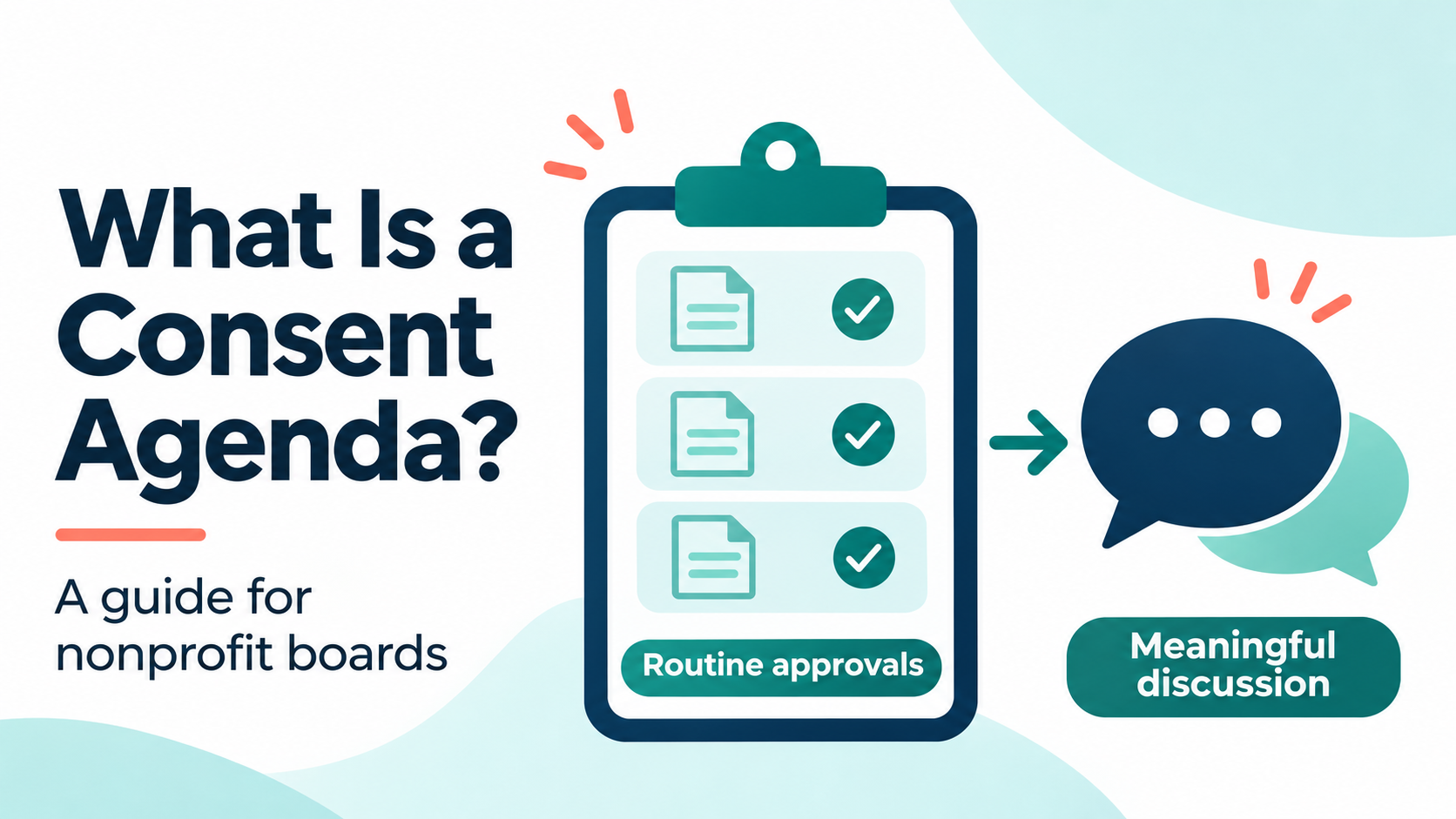
A consent agenda is a group of routine, non-controversial items that the board approves together with a single motion and a single vote. Instead of handling each item one at a time, the board adopts the whole bundle at once.
The key word is consent. These are items the board already agrees on, or would agree on without discussion. Board members review them ahead of time in the board packet, and if nobody has a concern, the board moves through all of them in under a minute.
The consent agenda doesn’t skip anything. Every item still gets approved and recorded in the minutes. It just stops the board from spending discussion time on things that don’t need discussion.
Why nonprofit boards use consent agendas
Board time is limited, especially for volunteer boards where directors are fitting meetings in after work. A consent agenda helps in a few practical ways.
It protects time for the work that matters. When routine approvals take two minutes instead of thirty, the board has room for strategy, fundraising, risk, and the questions that actually need a full conversation.
It rewards preparation. A consent agenda only works if members read the packet before the meeting. Over time, it builds a habit of showing up prepared, which improves every part of the meeting.
It keeps meetings focused. It’s much easier to stay on track when the agenda separates “approve and move on” items from “let’s talk about this” items.
It doesn’t sacrifice the record. Each item on the consent agenda is still approved and documented, so your minutes show exactly what the board adopted and when.
What goes on a consent agenda
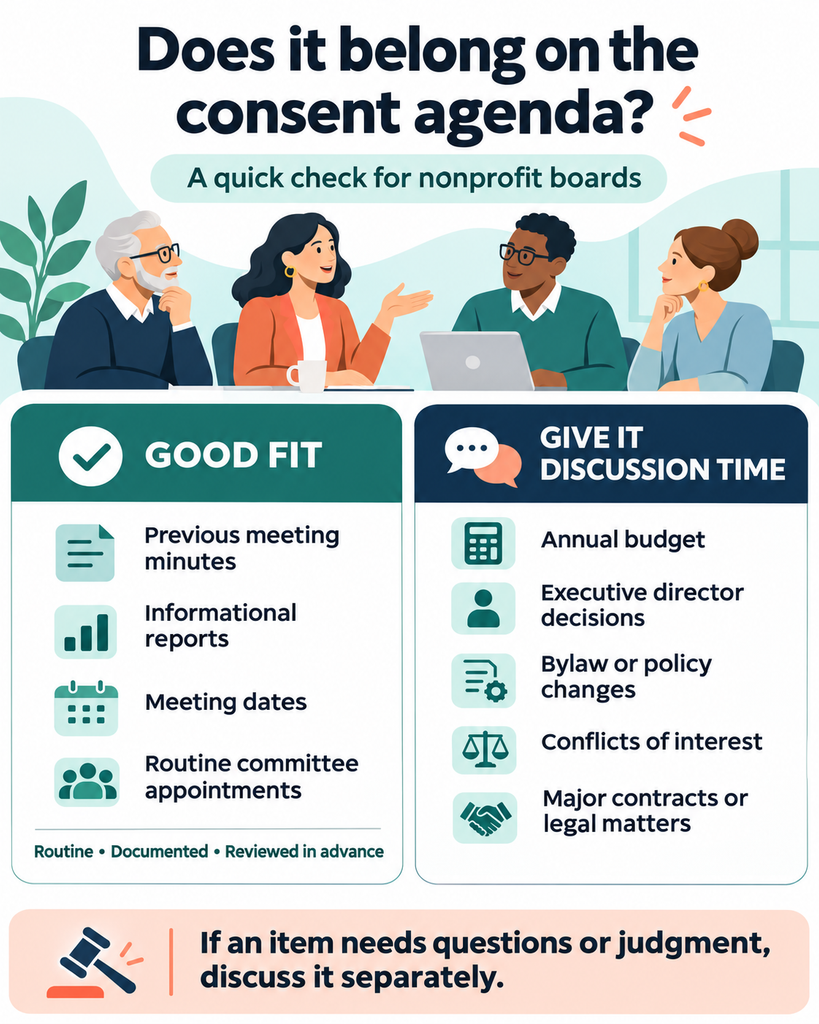
Good consent agenda items are routine, expected, and already reviewed. If an item has a clear recommendation and you’d be surprised to hear a question about it, it’s probably a good fit.
Common consent agenda items include:
- Approval of the previous meeting’s minutes
- Committee reports that are for information only and require no action
- The executive director’s or staff report, when it’s informational
- Routine financial reports that have already been reviewed by the finance committee
- Ratification of actions already taken under existing policy
- Confirmation of upcoming meeting dates and the annual calendar
- Routine appointments to committees that follow existing policy
- Acknowledgment of correspondence the board has received
Every item on the consent agenda should have its supporting documents attached in the packet. If members can’t review it in advance, it doesn’t belong on the consent agenda.
What should never go on a consent agenda
The consent agenda is for routine business only. Anything that involves real judgment, real money, or real risk deserves its own place on the agenda and its own discussion.
Keep these items off the consent agenda:
- Approval of the annual budget or major budget changes. This is one of the board’s core responsibilities and should always be discussed.
- The audit and financial statements. The board should hear from the audit committee or auditor and have time to ask questions.
- Executive director hiring, evaluation, or compensation. These are among the most important decisions a nonprofit board makes.
- Bylaw amendments and new policies. Changes to how the organization is governed need full discussion, and your bylaws may require a specific process or voting threshold.
- Anything involving a conflict of interest. If a board member needs to recuse themselves from an item, handle it separately so the recusal is clear in the record.
- Major contracts, property, loans, or legal matters. Anything with significant financial or legal exposure needs its own vote.
- Anything controversial or new to the board. If you expect a question, or the board is seeing it for the first time, it’s not routine.
A simple test: if you’d want the minutes to show that the board discussed it, don’t put it on the consent agenda.
How to pull an item off the consent agenda
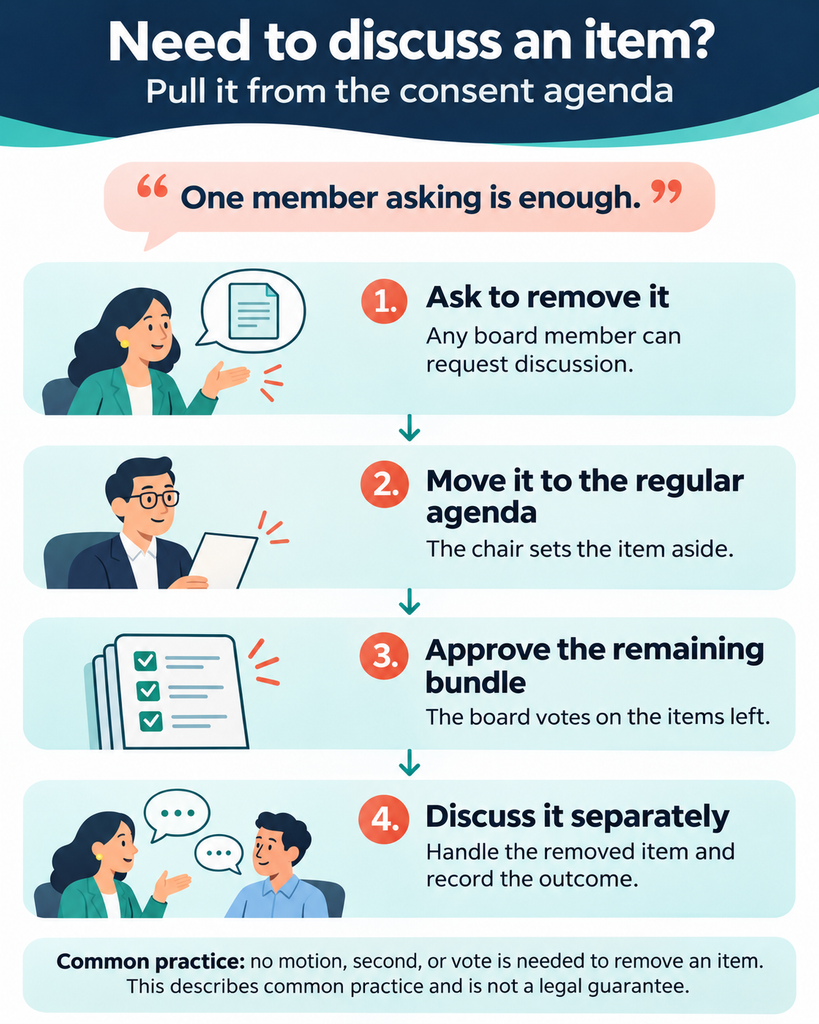
This is the safeguard that makes a consent agenda work. Any board member can ask to remove an item from the consent agenda, for any reason, and the item gets moved to the regular agenda for discussion.
Under common practice based on Robert’s Rules of Order, the request doesn’t need a motion, a second, or a vote. One member asking is enough. They don’t need to explain why. They might have a question, want more information, or simply think the item deserves a conversation.
Here’s how it usually works in the meeting:
- The chair presents the consent agenda and asks, “Does anyone wish to remove an item from the consent agenda?”
- If a member asks to remove an item, the chair moves it to the regular agenda, usually under new or unfinished business.
- Once all requests are made, the chair calls for a motion to approve the remaining consent agenda items.
- The board votes once, and all remaining items are approved.
- The removed item is discussed and voted on separately later in the meeting.
Chairs should make it clear that pulling an item is normal and not a challenge to anyone. The process only works if members feel comfortable using it.
It also helps to ask members to flag removal requests before the meeting when they can. That gives staff or committee chairs a chance to bring the right information, and the chair can plan time for the discussion.
A sample consent agenda structure
Most boards place the consent agenda near the start of the meeting, right after the call to order and approval of the agenda. That way, routine items are handled first and the rest of the meeting is free for discussion.
Here’s a simple structure you can adapt:
[Organization Name] Board of Directors Meeting Date | Time | Location or Video Link
1. Call to order (Chair, 2 minutes)
2. Approval of the agenda (Chair, 2 minutes)
3. Conflict of interest declarations (Chair, 2 minutes)
4. Consent agenda (Chair, 5 minutes)
- 4.1 Minutes of the September 24 board meeting
- 4.2 Executive director’s report (for information)
- 4.3 Finance committee report and August financial statements (reviewed by committee)
- 4.4 Governance committee report (for information)
- 4.5 Confirmation of 2027 board meeting dates
Motion: To approve the consent agenda as presented.
5. Items removed from the consent agenda (if any)
6. Discussion and decision items (45 minutes)
- 6.1 2027 operating budget (for approval)
- 6.2 Strategic plan update (for discussion)
- 6.3 Volunteer recruitment policy (for approval)
7. Generative discussion (20 minutes)
- 7.1 Board conversation on a strategic question or trend
8. Action items review (5 minutes)
9. Closed session (if needed)
10. Adjournment
Notice how much of the meeting is left for discussion once the routine items are bundled together. That’s the whole point.
If you want a ready-made starting point, our free Board Meeting Agenda Template includes time allocations, a consent items section, and space for decisions.
Tips for making your consent agenda work
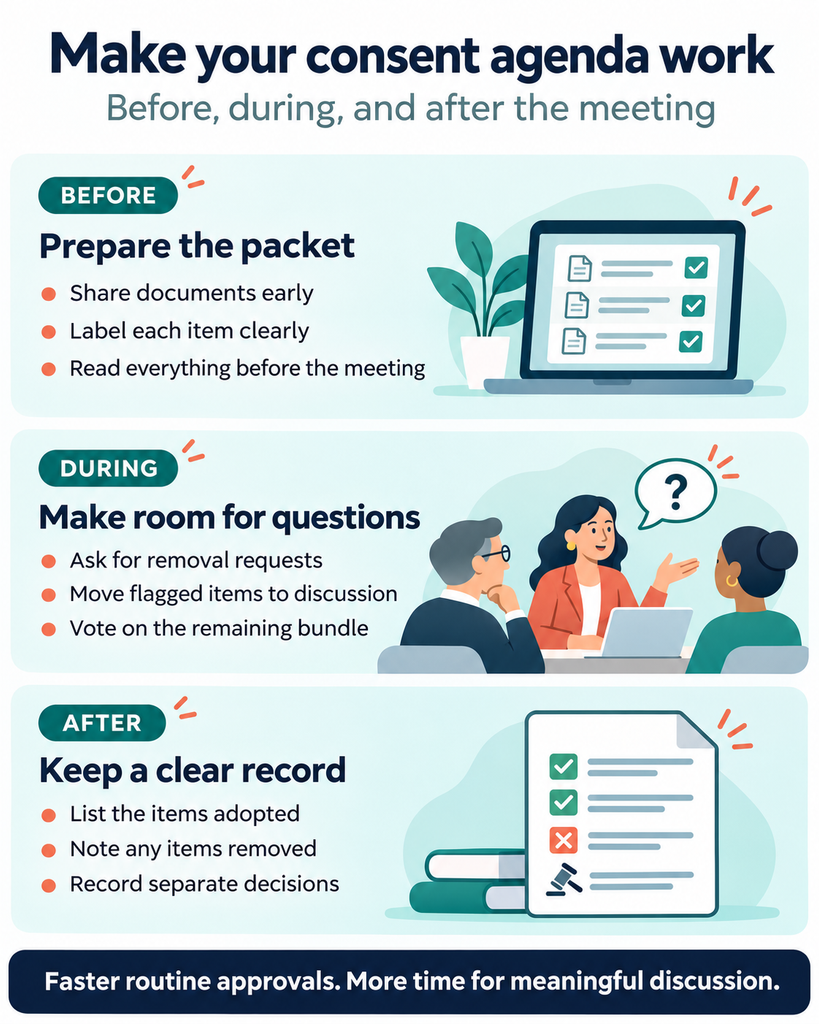
Get the packet out early. Members need time to read before the meeting. Aim to send the board packet at least five to seven days in advance. If the packet shows up the night before, the consent agenda turns into a rubber stamp.
Label every item clearly. Mark each agenda item as for information, for discussion, or for approval. It tells members what’s expected and makes the consent agenda easier to build.
Attach the documents to the item. Members shouldn’t have to dig through email to find the report that goes with item 4.3. Link each document directly to its agenda item.
Explain it to new board members. If your board is new to consent agendas, walk through how it works at orientation and at the start of the first meeting where you use one. Make sure everyone knows they can pull an item.
Check your bylaws. Most boards can adopt a consent agenda by simply approving the meeting agenda, but some organizations also adopt a short board policy describing how it works. If your bylaws have rules about meeting procedure, confirm a consent agenda fits within them.
Record it properly in the minutes. The minutes should show that the consent agenda was adopted and list every item it included. If an item was removed, the minutes should note that and record the separate discussion and vote.
How BoardSite helps you run a consent agenda
A consent agenda depends on two things: members reviewing the material before the meeting, and a clean record of what was approved. That’s hard to manage when agendas, reports, and attachments are spread across email threads and shared drives.
In BoardSite, the agenda and minutes builder lets you group consent items together and link the supporting documents, votes, and presenters to each line item. Clone last month’s agenda to keep your structure consistent, and share the full packet with everyone in one click.
During the meeting, members follow along in the Meeting Viewer and can open any report on the spot. Minutes are recorded against each agenda item, so your record shows exactly what was approved on consent and what was pulled for discussion. When a decision needs a formal vote between meetings, online voting keeps a record of who voted, who abstained, and when.
Six months from now, when someone asks when the board approved the committee appointments, it takes seconds to find.
Frequently asked questions
Is a consent agenda the same as a “consent calendar”?
Yes. Some organizations, particularly public bodies and school boards, use the term consent calendar. It works the same way: routine items are approved together in a single vote.
Does a consent agenda need a motion?
Yes. After any items are removed, the chair calls for a motion to approve the consent agenda, and the board votes once on all remaining items. Many boards use the wording “to approve the consent agenda as presented.”
Can the chair refuse a request to remove an item?
Under common practice, no. If any member asks to remove an item, it comes off the consent agenda and moves to the regular agenda for discussion. That’s what keeps the process fair.
How many items should be on a consent agenda?
There’s no set number. It depends on how much routine business your board handles. What matters is that every item is routine, documented, and has been available for review ahead of the meeting.
Can committees use consent agendas too?
Yes. Finance, governance, and other committees can use the same approach for routine items like approving their own minutes, which keeps committee meetings focused too.
Get your next meeting back
A consent agenda is a small change with a big payoff. It takes a few minutes to set up, and it gives your board back the time it needs for the conversations that move your organization forward.
For more ways to run focused meetings, read The Board Meeting Playbook: Best Practices for In-Person and Virtual Boards. Or see how your board is doing with a free Board Health Score. It takes about five minutes and no signup is required.
Ready to put it into practice? Use BoardSite for your next meeting. The free trial covers up to 60 days, and no card is required.
[boardsite_article_endmatter]