
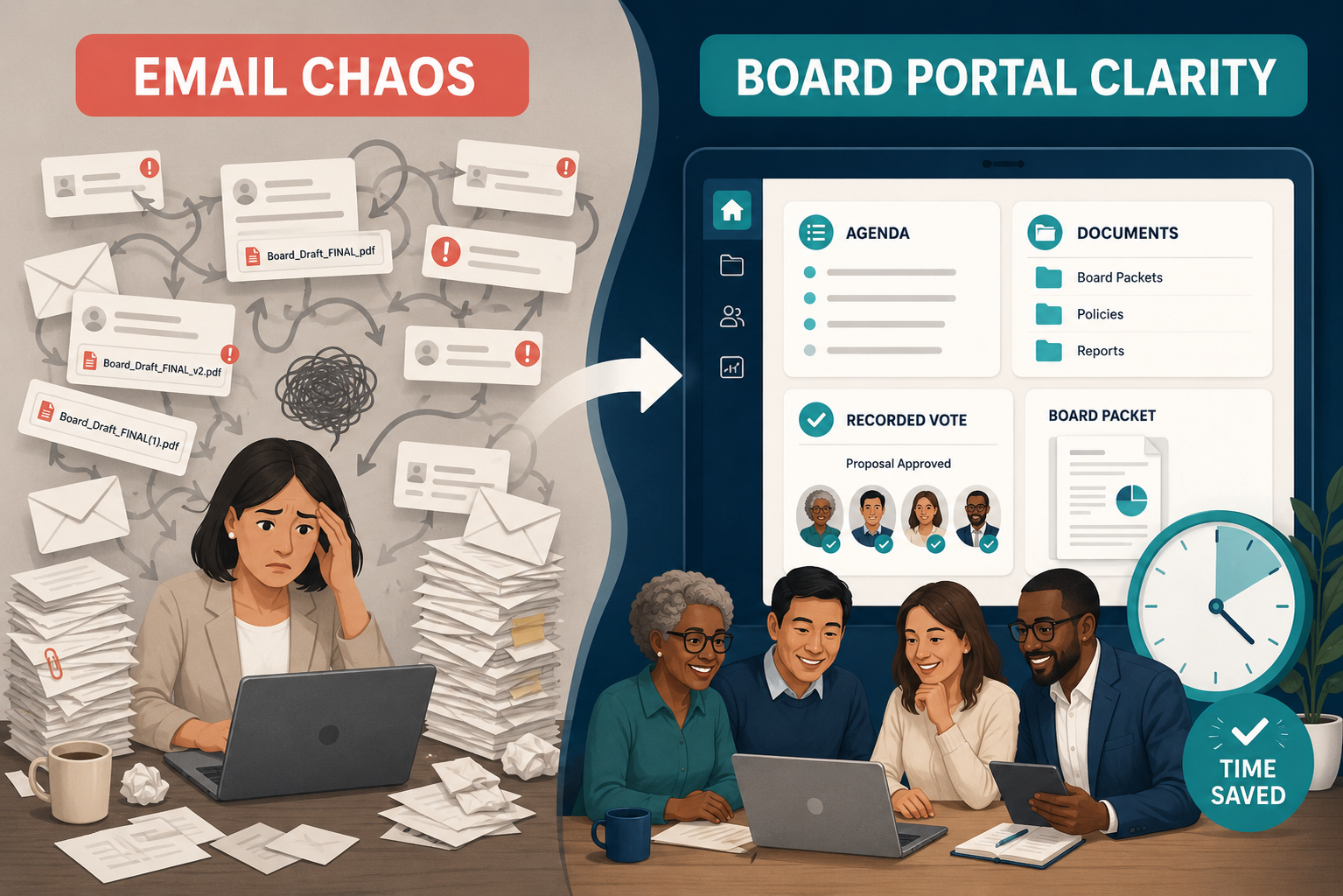
Email got your board through the early years. It is free, everyone already has it, and it felt like enough when your board was five people who all knew each other well. But nonprofits grow, boards turn over, and governance gets more complicated. At some point, the same inbox that used to keep everyone in the loop starts working against you.
If you are a board chair or executive director wondering whether it is time for something more structured, here are five signs your nonprofit has outgrown email and could benefit from board portal software for nonprofits.
1. Your board packet is scattered across a dozen email threads
Ask yourself this: if a new board member joined today, could they find last quarter’s financials, the current bylaws, and the minutes from the last three meetings without asking someone to dig through their inbox?
For most email-run boards, the honest answer is no. Documents get attached to different threads, renamed inconsistently, and buried under replies that have nothing to do with the original topic. Board members end up asking staff to resend files that technically already exist somewhere in their inbox. That is not a board member problem. It is a system problem, and it is one of the clearest signs your current setup has hit its limits.
2. Voting by email feels risky, not efficient
Email voting is common in small nonprofits because it is quick to set up. The trouble shows up later. Reply-all threads get confusing when votes and side comments blend together. Records of who voted, how, and when are hard to reconstruct months down the line. If a funder, auditor, or new board member ever asks to see your voting history, pulling it together from an inbox is a slow and stressful task.
Boards have a fiduciary duty to keep accurate records of their decisions. When your voting process depends on people replying correctly to the right thread, you are trusting the system to your board’s email habits rather than to a process built for accountability.
3. Onboarding a new board member takes weeks instead of days
Bringing on a new director should be a chance to get fresh energy and perspective into your governance. Too often, it turns into weeks of forwarding old emails, sending password-protected PDFs, and trying to reconstruct a year’s worth of context from memory.
If new board members regularly say they feel behind for their first two or three meetings, that is not a reflection of their effort. It is a sign that your institutional knowledge lives in individual inboxes instead of somewhere new members can access on their own. A board that cannot onboard efficiently is a board that struggles to grow.
4. Meeting prep eats up hours your team does not have
Someone on your team is probably spending real time every month pulling together the agenda, formatting the board packet, chasing down documents from three different people, and emailing the final version out one attachment at a time. Then doing it again for the next meeting.
That time adds up fast, and it is time that could go toward your actual mission instead of administrative assembly work. When meeting prep starts to feel like a part time job for whoever is unlucky enough to own it, that is a strong signal your process needs to change, not just your effort level.
5. You cannot answer basic governance questions with confidence
Funders and grant makers increasingly want to see evidence of strong governance before they write a cheque. So do larger donors and community stakeholders who want reassurance their contributions are overseen responsibly.
Can you quickly show a complete record of board meetings for the past year? Can you produce clean minutes, agendas, and voting history on request? If pulling that information together means searching through years of email and hoping nothing was missed, your governance may be sound in practice but hard to prove on paper. That gap matters more than it might seem, especially as your organization grows and the questions get more detailed.

What this actually means for your nonprofit
None of these signs mean your board is doing anything wrong. They mean your board has grown past what a shared inbox was ever designed to handle. Email is a communication tool, not a governance system. It was never built to store institutional history, track votes with accountability, or make onboarding simple.
The good news is that recognizing these signs early gives you time to make a thoughtful choice instead of a rushed one. Nonprofits that wait until a governance gap becomes a real problem, like a missing vote record during an audit, often end up choosing a solution under pressure rather than on their own terms.
If any of these five signs sound familiar, it is worth taking a closer look at what board portal software for nonprofits can actually do for your organization, and how to think through the options that fit your size, budget, and governance needs. Our buyer’s guide walks through exactly that, so you can move from recognizing the problem to choosing the right fix with confidence.
[boardsite_article_endmatter]