Congratulations, you said yes. Maybe a friend recruited you. Maybe you’ve volunteered for years and finally got the call. Either way, you now have a seat at the table, and with it comes real responsibility for an organization you care about.
The first few months on a board are when habits form. New members who take the time to learn how the board works, what the numbers mean, and where to find things tend to become the ones who speak up with confidence. New members who don’t often spend their first year quietly trying to catch up.
This checklist breaks your first 90 days into manageable stages. You don’t have to do everything at once, and you don’t need to be an expert in governance, finance, or parliamentary procedure on day one. You just need a plan.
How to Use This Checklist
Every board is a little different. A three-person startup board, a 25-member association board, and a condo or HOA board will all run things their own way. Treat this list as a starting point and adjust it based on what your board chair and executive director tell you.
If your organization runs a formal orientation, a lot of these items will be covered there. If it doesn’t, this checklist helps you fill in the gaps on your own. Want something you can print and share with your chair? Grab the free Orientation Checklist from our Templates & Guides library.
Before Your First Meeting: Get the Basics in Hand
Gather the core documents
You can’t make good decisions without context. Ask for these documents early, ideally before your first meeting:
- Bylaws
- Mission statement and articles of incorporation
- Current strategic plan
- This year’s budget and the most recent financial statements
- Minutes from the last six to 12 months of board meetings
- Board policies, such as conflict of interest, whistleblower, and document retention
- A board roster and committee list with contact information
- The meeting calendar for the year
- A board member job description, if your organization has one
If your board uses BoardSite, most of this should already be waiting for you in the document library. Take advantage of it. Reading past agendas and minutes is one of the fastest ways to understand what the board has been working on and why. We dig into that idea more in Building Board Engagement Through Transparency.
Get set up in your board portal
A few minutes of setup now saves you from digging through your inbox the night before a meeting. If your organization uses BoardSite, here’s what to do first:
- Open your welcome email and log in to your account
- Walk through the Board Member: Getting Started Guide for a quick tour of your dashboard, documents, and discussions
- Update your profile and add a photo so other members can put a face to your name
- Turn on two-factor authentication to keep board information secure
- Download the BoardSite mobile app for iOS or Android
- Subscribe to your BoardSite calendar so meetings show up alongside everything else in your week
- Set up announcement updates and push notifications so you don’t miss anything important
Your dashboard is your home base. It shows upcoming meetings, open votes, announcements, and anything else that needs your attention. Get in the habit of checking it once or twice a week.
Sign what needs signing
- Complete a conflict of interest disclosure (see our free Conflict of Interest Policy template if your board doesn’t have one)
- Review and sign any code of conduct or confidentiality agreement
- Ask whether the organization carries directors and officers (D&O) insurance
That last one surprises a lot of new members. D&O insurance helps protect board members if the organization or the board is ever named in a lawsuit. It’s a fair question to ask, and a good organization will have a clear answer.
Schedule a few key conversations
- Meet with the board chair
- Meet with the executive director or CEO
- Ask whether you can be paired with a mentor or “board buddy”
These don’t need to be formal. A 30-minute coffee or video call is plenty. Here are a few good questions to bring:
- What are the biggest issues the board will face this year?
- What do you wish new members knew before their first meeting?
- How does the board usually make decisions?
- Where do you see my skills being most useful?
- What’s expected of board members when it comes to fundraising?
A board buddy is especially valuable. Having someone you can text a quick question to (“What does this line in the budget mean?”) makes the learning curve a lot less steep.
Days 1 to 30: Learn How Your Board Works
Understand your legal responsibilities
As a board member, you’re a fiduciary. That’s a formal way of saying you’re trusted to act in the best interest of the organization, not yourself. Most boards describe this through three core duties:
- Duty of care: Pay attention, come prepared, and make informed decisions. Reading the board packet is part of this duty, not an extra.
- Duty of loyalty: Put the organization’s interests ahead of your own. That means disclosing conflicts of interest and stepping out of votes where you have one.
- Duty of obedience: Make sure the organization follows the law, its bylaws, and its own policies, and stays true to its mission.
You don’t need to memorize legal definitions. You just need to show up, do the reading, ask questions when something doesn’t make sense, and be upfront about any potential conflicts.
Learn the meeting rhythm
Every board has its own routine. Figure out the basics early so nothing catches you off guard:
- How often does the board meet, and for how long?
- Are meetings in person, virtual, or hybrid?
- Who builds the agenda, and how can you add an item?
- When does the board packet usually go out?
- Does the board follow Robert’s Rules of Order or a more informal process?
- How are votes handled between meetings?
- Which committees meet, and when?
If your board uses online voting, take a minute to read how voting works in BoardSite before your first vote comes up. It’s much easier than tracking a long “Reply All” email chain.
Get to know the consent agenda
If there’s one meeting term every new board member should understand early, it’s the consent agenda.
A consent agenda groups routine, non-controversial items together so the board can approve them all with a single vote. Common examples include approving the last meeting’s minutes, accepting committee reports, and confirming routine appointments. It saves time so the board can focus its discussion on the bigger issues.
Here’s what new members need to know:
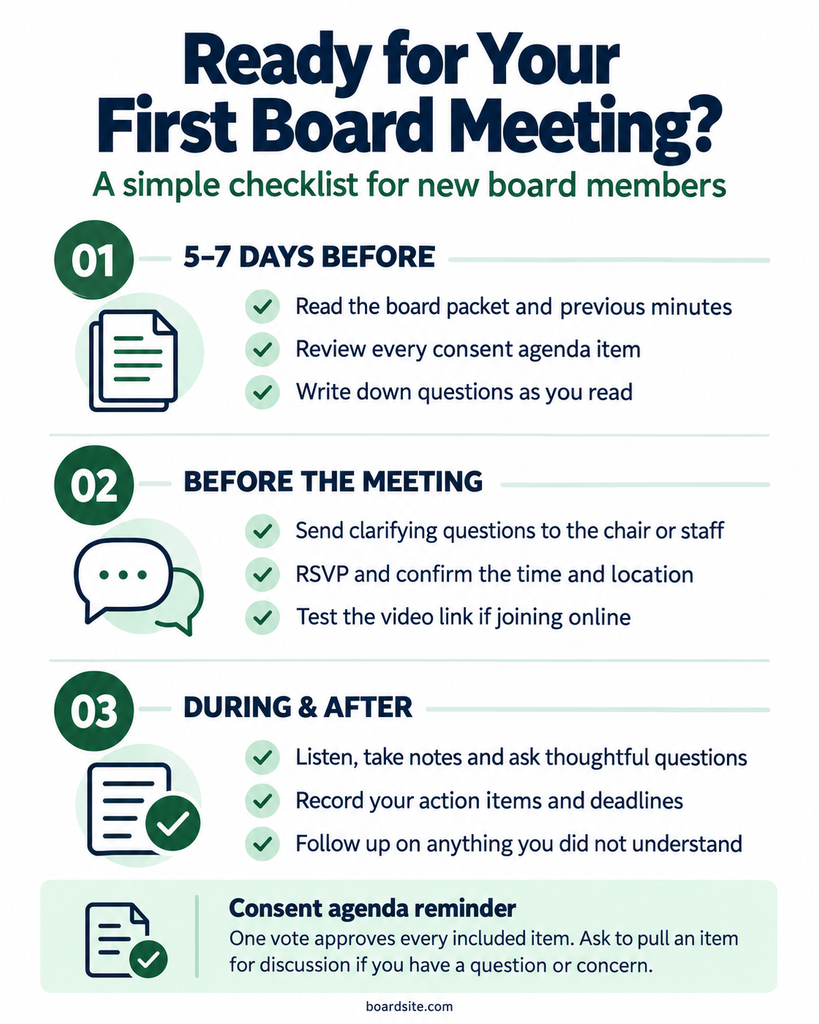
- Approving the consent agenda means approving everything in it. One vote covers every item, so read each one before the meeting.
- You can ask to pull an item. If something on the consent agenda raises a question or concern, any board member can ask to move it to the regular agenda for discussion.
- A heads-up helps. If you plan to pull an item, letting the chair know before the meeting keeps things running smoothly.
For a complete walkthrough, read Consent Agenda 101: What Every Board Member Should Know.
Prepare for your first meeting
- Start reviewing the board packet five to seven days ahead
- Read the minutes from the last meeting
- Read every item on the consent agenda
- Jot down questions as you go
- Send any quick clarifying questions to staff or the chair before the meeting
- RSVP through your board portal
- Test your video link ahead of time if the meeting is virtual or hybrid
Our New Board Member’s Q&A Guide covers first-meeting prep in more detail, including what to expect from orientation and how to read a board packet.
At your first meeting
- Listen more than you talk, but don’t be afraid to ask a question
- Notice how discussion flows and how decisions actually get made
- Write down any action items assigned to you
- Follow up on anything you didn’t understand
Nobody expects you to have all the answers in your first meeting. A thoughtful question like “Can you help me understand how this fits into the strategic plan?” shows you’re engaged without pretending to know more than you do.
Days 31 to 60: Go Deeper
Get comfortable with the finances
You don’t need to be an accountant, but every board member shares responsibility for the organization’s financial health. That makes the numbers everyone’s business, not just the treasurer’s.
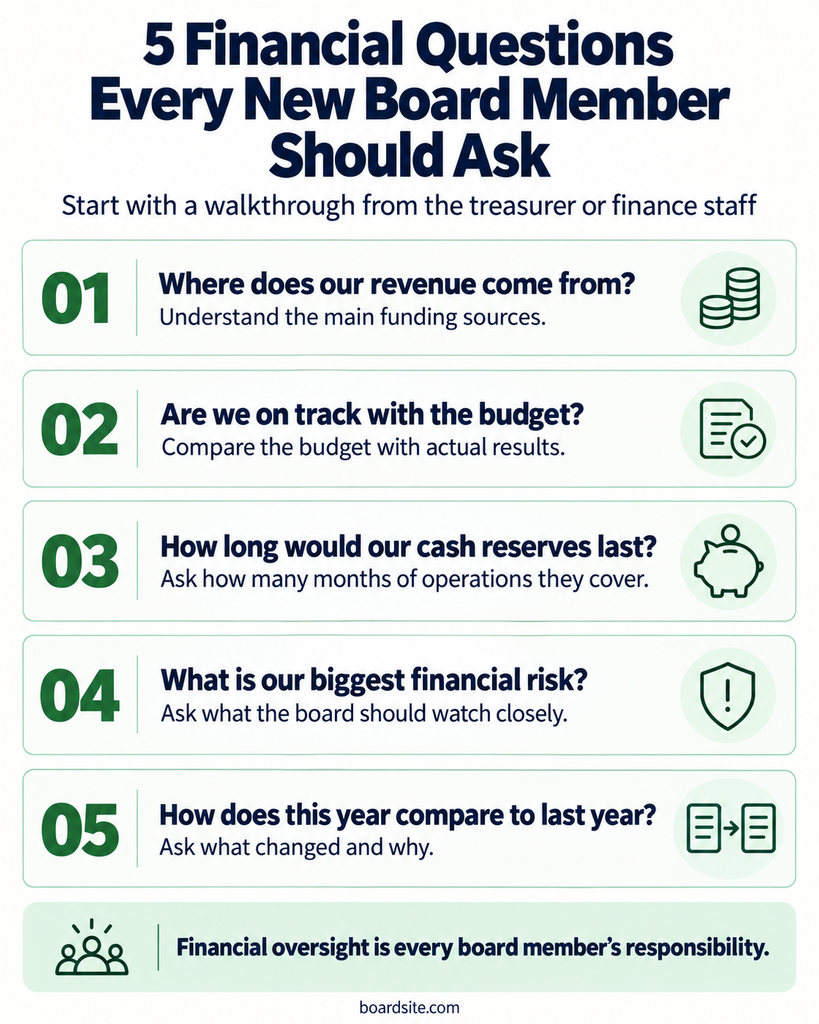
- Ask the treasurer or finance staff for a 30-minute walkthrough of the financial statements
- Learn where the organization’s revenue comes from
- Compare the budget to actual results so far this year
- Ask about cash reserves and how many months of operations they would cover
- If you’re on a U.S. nonprofit board, review the organization’s most recent Form 990
Good questions to ask include: “Are we on track with the budget?” “What’s our biggest financial risk right now?” and “How does this year compare to last year?” If your board is looking for better tools here, our Templates & Guides page includes a free Nonprofit Budget Template, Financial Dashboard, and Financial Oversight Policy.
Join a committee
Committees are where much of a board’s real work happens. They’re also one of the best ways to learn the organization quickly.
- Ask the chair which committees need help
- Pick one that matches your skills or interests
- Attend your first committee meeting
- Find the committee’s documents and past reports in your portal
In BoardSite, each committee can have its own committee page with separate documents and discussions, so you can keep committee work organized and separate from full-board materials.
See the mission in action
- Visit a program, event, or facility
- Talk with a few staff members or volunteers
- Have one-on-one conversations with two or three fellow board members
Reading reports tells you what the organization does. Seeing it firsthand tells you why it matters. It also gives you real-world context when the board discusses programs, budgets, and priorities.
Stay involved between meetings
Board work doesn’t stop when the meeting ends. Get into a simple routine:
- Check your dashboard weekly for new votes, tasks, and announcements
- Keep track of your assigned tasks and mark them complete
- Join board discussions instead of starting long email threads
- Use advanced search to find past decisions and documents when you need background
Days 61 to 90: Start Contributing
By now you know the people, the process, and the priorities. This is when you start moving from learning to leading.
- Come to each meeting with at least one thoughtful question or idea
- Understand your fundraising expectations, including any personal giving or “give or get” commitment
- Identify one area where your professional skills can help, whether that’s marketing, finance, legal, HR, or something else
- Offer to take on a small project or task
- Schedule a 90-day check-in with your chair
Have a 90-day check-in
This conversation is easy to skip, but it’s one of the most valuable things you can do. Ask your chair:
- How am I doing so far?
- Is there anything I should be doing differently?
- What should I focus on for the rest of the year?
- Is there a committee or leadership role I should consider down the road?
Take part in board evaluations
If your board runs a self-assessment or board evaluation, participate fully, even if you’re new. Fresh eyes often notice things long-serving members have stopped seeing. If you’re asked to complete one in BoardSite, here’s how to complete an evaluation.
Keep learning
Good board members never stop learning. BoardSite Academy offers board governance training and certification, and our Resources hub is packed with practical guides, from running better meetings to understanding your role.
Common First-Year Mistakes to Avoid
Most new board members make at least one of these. Knowing about them ahead of time makes them easier to avoid:
- Staying quiet too long. Waiting until you “know enough” to speak up can turn into a whole year of silence. Your outside perspective is part of why you were asked to join.
- Getting into the weeds of operations. The board sets direction and provides oversight. Staff run the day-to-day. Offering help is great, but directing staff work usually isn’t your role.
- Skimming the consent agenda. Remember, one vote approves every item. Read them all.
- Relying on email for everything. Documents scattered across inboxes are easy to lose. Keep board materials in your board portal where everyone can find them.
- Not disclosing a conflict. When in doubt, disclose. It protects you and the organization.
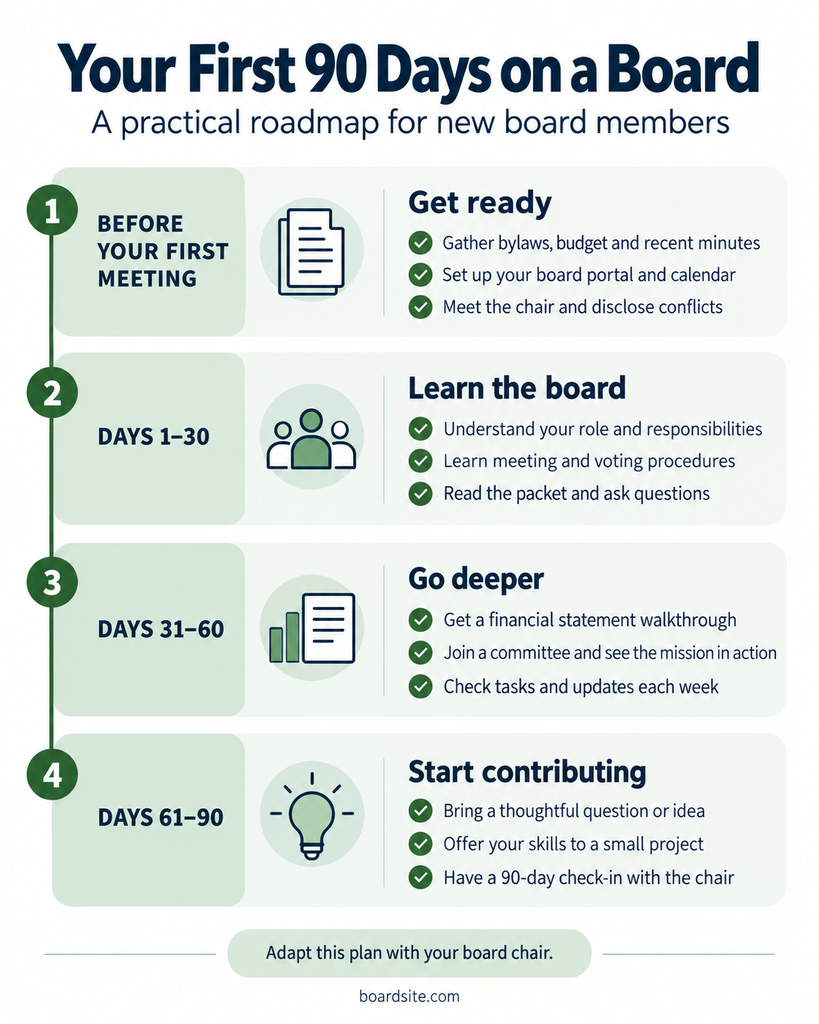
Your 90-Day Checklist at a Glance
Before your first meeting
- Collect bylaws, strategic plan, budget, financials, policies, and recent minutes
- Set up your board portal, profile, two-factor authentication, and mobile app
- Sign your conflict of interest disclosure
- Ask about D&O insurance
- Meet with your chair and executive director
- Ask for a board buddy
Days 1 to 30
- Learn your three fiduciary duties
- Learn the meeting rhythm and how votes work
- Understand the consent agenda
- Review the board packet five to seven days before your first meeting
- Attend your first meeting and follow up on questions
Days 31 to 60
- Get a walkthrough of the financial statements
- Join a committee
- Visit a program or event
- Build a weekly habit of checking your dashboard, tasks, and discussions
Days 61 to 90
- Contribute at least one question or idea per meeting
- Clarify your fundraising expectations
- Find where your skills fit best
- Hold a 90-day check-in with your chair
- Take part in board evaluations and ongoing training
Frequently Asked Questions
How long does it take a new board member to get comfortable?
It varies, but most members start to feel settled after two or three meetings. Having a clear plan for your first 90 days, a mentor to turn to, and easy access to past board materials can speed that up a lot.
What documents should a new board member ask for?
At a minimum, ask for the bylaws, strategic plan, current budget and financial statements, recent meeting minutes, board policies, and a list of board members and committees. A board member job description is also helpful if your organization has one.
Can new board members vote at their first meeting?
In most cases, yes. Once your term officially begins under the bylaws, your vote counts the same as everyone else’s. That’s why reading the board packet before your first meeting matters so much.
What is a consent agenda?
A consent agenda is a group of routine items, like approving previous minutes or accepting committee reports, that the board approves with a single vote. Any board member can ask to pull an item for separate discussion. Learn more in our Consent Agenda 101 guide.
What if my board doesn’t have a formal orientation?
Use this checklist as your own orientation. Share it with your chair and ask for help gathering the documents and setting up the key conversations. It may even help your board build a better process for the next new member. Our article on onboarding new board members is a great resource to pass along.
Make Your First 90 Days Easier with BoardSite
The hardest part of being a new board member usually isn’t the work itself. It’s finding what you need. Past minutes are buried in someone’s inbox, the latest budget is attached to a different email thread, and nobody is quite sure which version of the agenda is final.
BoardSite puts your meetings, documents, votes, discussions, and tasks in one organized place, so new members can get up to speed in days instead of months. It’s free for teams of ten, and paid plans start at $149 per month.
Get your Board on the same page with BoardSite for your organization today.
[boardsite_article_endmatter]